AI Tattoo Designs: Why the Picture You Love May Be Impossible to Tattoo
9/4/2026
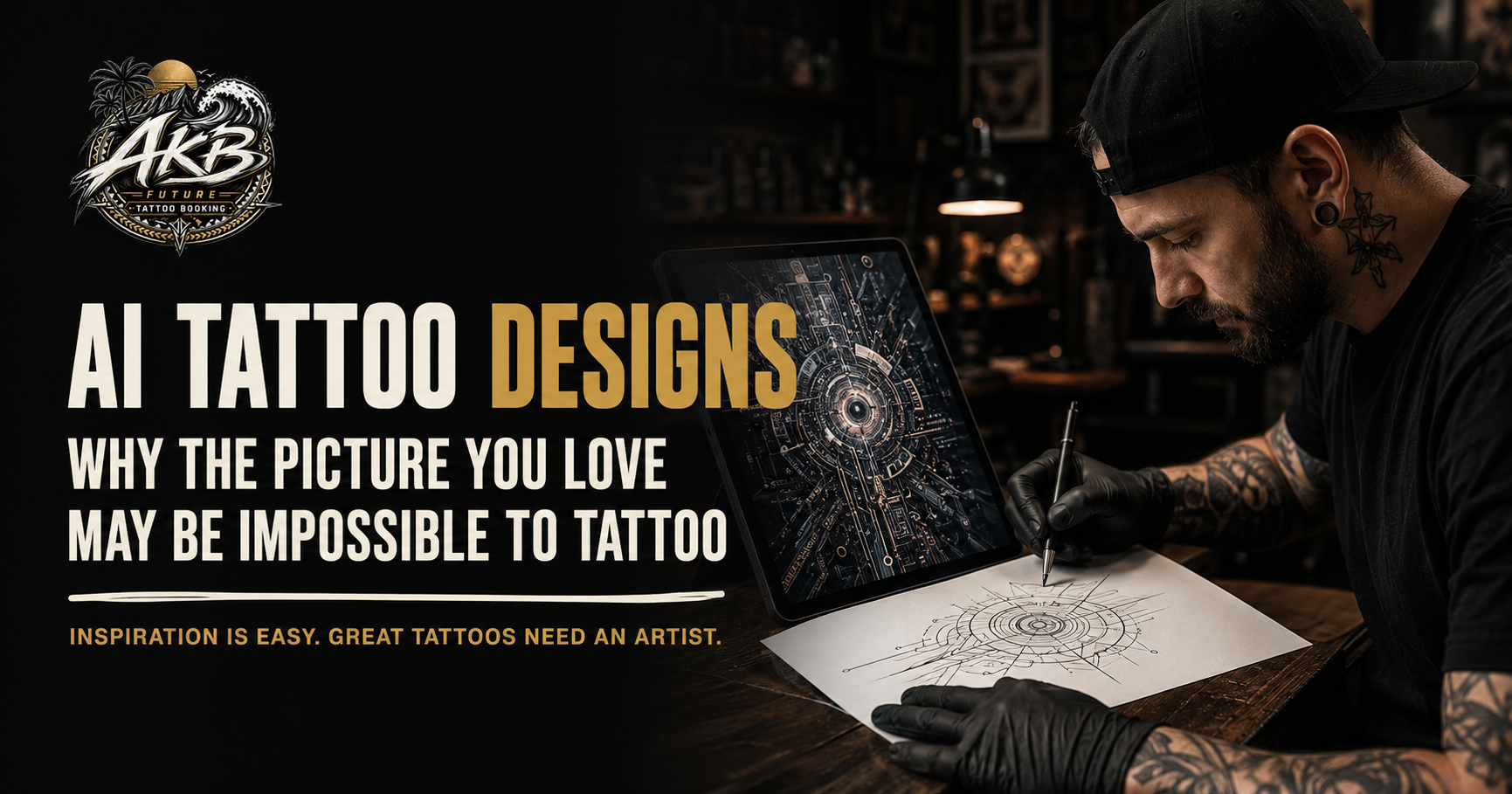
AI can create a tattoo image in seconds—but that does not make it tattoo-ready. Learn why artists redraw AI references for body flow, readability, and long-term aging.
AI can make a tattoo design look incredible in seconds.
It can combine a lion, a clock, a city skyline, three names, smoke, roses, an angel and a family quote into one dramatic image before you have even finished explaining the idea.
There is just one problem:
A cool picture is not automatically a good tattoo.
More clients are bringing AI-generated references into tattoo consultations. That is not necessarily a bad thing. AI can help someone communicate a mood, composition or idea that was difficult to put into words. But when a tattoo artist says the image needs to be simplified, resized or completely redrawn, the artist is not rejecting your vision.
They are trying to make sure it works on a human body—and still looks good years from now.
AI Designs Are Made for Screens, Not Skin
A phone screen can display thousands of tiny details with perfect contrast. Skin cannot.
Tattoo ink settles and changes over time. Fine gaps may close, tiny details can lose definition and low-contrast areas can become harder to read. A design that looks sharp when it is brightly lit and zoomed in on your phone may turn into visual noise when it is reduced to six inches on an arm.
That is why an experienced artist thinks beyond the first-day photograph. They consider:
How the design will read from a normal distance
Whether the smallest details have enough room
How the line weights and shading will settle
Whether the placement gets heavy sun, friction or movement
How the tattoo will look as the body bends and turns
AI sees a flat image. A tattoo artist sees the next 10 years.
Your Body Is Not a Flat Canvas
One of the biggest weaknesses of an AI tattoo reference is body flow.
Arms taper. Shoulders curve. Chests expand. Knees bend. A design that looks balanced inside a rectangle may look awkward once it wraps around muscle and bone.
This matters even more with large-scale work, sleeves, ornamental designs and Polynesian-inspired tattoos. These pieces need to respond to the individual body. The direction of the lines, the balance of the negative space and the way the design connects across different angles all matter.
The strongest tattoos do not look pasted onto the body. They look like they belong there.
AI Can Create Details That Cannot Be Tattooed Cleanly
AI images often hide mistakes inside impressive-looking detail. Zoom in and you may find broken geometry, patterns that lead nowhere, unreadable lettering, impossible shadows or objects that blend into one another.
On a screen, your eye may forgive those mistakes. In a tattoo, every mark has to be intentionally placed by the artist.
Common problems include:
Lettering that looks like words but is actually nonsense
Too many focal points fighting for attention
Micro-details packed into an area that is too small
Lighting and shadows that contradict each other
Symmetry that falls apart when the design is examined closely
Cultural symbols mixed together without understanding their meaning
The image may feel finished, but the artist still has to solve it.
The Cultural Problem Matters Too
AI does not understand cultural responsibility.
It can pull visual elements from Polynesian, Filipino, Māori, Japanese, Indigenous and other traditions, then combine them because they look similar to the program. That does not mean those elements share the same history or meaning.
If your tattoo represents your family, culture or identity, an algorithm should not be the final authority on what belongs in it.
A knowledgeable artist can ask about your background, your story and what you actually want the tattoo to represent. That conversation is part of the design process. Meaning should be intentional—not an accident created by a prompt.
Does This Mean You Should Never Use AI for Tattoo Ideas?
No. AI can be useful as a starting point.
Use it like a mood board, not a stencil.
An AI image can help show your artist:
The overall feeling you want
Subjects or symbols you are considering
A preferred level of darkness or contrast
A general composition
Styles you are curious about
Then let the tattoo artist translate that inspiration into an original design that fits your body, can be executed cleanly and has a better chance of aging well.
The best sentence you can say during a consultation is:
“I like the direction of this, but I want you to make it work as a tattoo.”
That gives the artist useful information without asking them to copy a computer-generated image line for line.
Why Your Artist May Change the Design
If the artist recommends making the piece larger, removing an element, increasing the contrast or changing the placement, listen to the reason.
They may be protecting the most important part of your idea.
Simplifying a design does not always make it less meaningful. Often, it makes the message clearer. Increasing the size is not always an attempt to charge more. Sometimes it is the minimum space needed for the tattoo to remain readable. Moving the placement may be what allows the composition to flow naturally.
A professional artist is not only thinking about what earns a like today. They are thinking about what you will still be proud to wear later.
The Red Flag Is Not AI—It Is Skipping the Artist
The real problem begins when someone treats the generated image as a finished product and looks for the cheapest person willing to trace it.
That removes the most valuable part of tattooing: the judgment, experience and creativity of the artist.
You are not only paying someone to operate a tattoo machine. You are paying them to know what to keep, what to change, what will fit, what will heal and what should never have been in the design in the first place.
AI can generate the picture. It cannot take responsibility for the tattoo.
Final Takeaway
Bring the AI image. Bring screenshots. Bring rough sketches, notes and every strange idea in your head.
Just do not become so attached to one generated picture that you ignore the person who actually understands tattooing.
Use AI to begin the conversation—not end it.
Because inspiration may be instant, but a great tattoo still needs a real artist.
Ready to Find the Right Artist?
AKB Future helps connect clients with artists based on style, location and the kind of tattoo they actually want—not simply who is available first.
Browse the AKB Future artist roster or submit a booking request at AKBFuture.com.
Ready to book?
Submit an inquiry and AKB Future will match you with the right artist.
Start Booking Inquiry